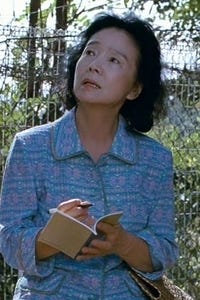
• Summary: A sixty-something woman, faced with the discovery of a heinous family crime, finds strength and purpose when she enrolls in a poetry class. Lee Chang-dong's follow-up to his acclaimed Secret Sunshine is a masterful study of the subtle empowerment — and moral compass — of an indefatigable older woman. (Kino International) Expand
Score distribution:
  1. Positive: 19 out of 19
  2. Mixed: 0 out of 19
  3. Negative: 0 out of 19
  1. Reviewed by: G. Allen Johnson
    Apr 7, 2011
    100
    A heartrending film, Lee's Poetry is indeed a work of art.
  2. Reviewed by: Joe Williams
    Apr 8, 2011
    100
    Beauty comes to us unexpectedly. That's the message of Poetry, a Korean movie about an aging housemaid that turns out to be one of the best films of the year.
  3. Reviewed by: Kenneth Turan
    May 5, 2011
    100
    Daring in the ways only quiet, unhurried but finally haunting films have the courage to be. A character study of remarkable subtlety joined to a carefully worked-out plot that fearlessly explores big issues like beauty, truth and mortality, it marks the further emergence of Korean writer-director Lee Chang-dong.

See all 19 Critic Reviews

Score distribution:
  1. Positive: 4 out of 6
  2. Mixed: 0 out of 6
  3. Negative: 2 out of 6
  1. 10
    This review contains spoilers, click expand to view. What's that thing called when a group of young school-aged boys coerce an innocent girl, a classmate, to engage in rounds of repeated sexual intercourse against her will over the course of six weeks? It's not "wallet" or "bus terminal", but be patient with Mija(Yun Jung-Hee), a beautiful, somewhat self-possessed grandmother in her mid-sixties who was recently diagnosed with the early signs of Alzheimer's Disease. You'll have to excuse Mija. Her mind is, understandably, a little hazy, and in addition to her condition, the old woman is a little set in her ways. Like any aging woman, Mija likes routine. Like clockwork, she cooks and cleans for her M.I.A. daughter's subordinate, and supplements her welfare checks with a caretaking job where she looks after a disabled old man. That's her world, her bubble. But that world is about to change. And pop. She just enrolled in a poetry class. The word which eludes the literary upstart at the start of her emotional journey will come to her by course's end. For the time being, Mija finds herself in a constant struggle with language, but the poetic inspiration she seeks gives a wide berth to her eager mind, but it can't be solely attributed to the effects of the fast-approaching disease. On the literary class' first day, the earnest instructor tells his pupils that "the most important thing in life is seeing," and for Mija, being able to see extends beyond the ability to describe an apple, or a beautiful flower, or the mysteries of birdsong. But she can't. She has blinders on. She loves her grandson. "Poetry" begins with the aftermath of a suicide, when a group of boys playing down by the riverside notice a motionless body turned faced down, advancing cryptically towards them, dictated by the water's currents. In a diary kept by the girl detailing her nightmarish ordeal, the principal characters in this morality play could easily deduce that she jumped, as if the collected auras of the repugnant boys with their phallic weapons were there with the spent girl at the bridge on that fateful spring day to do the pushing themselves. Set in a South Korean small town, "Poetry" subtly suggests how the nihilistic American subculture of sex, drugs, and rock and roll has infiltrated the mindsets of the Asian youth, therefore tossing aside the values practiced by preceding generations of eastern peoples, turning their thoughtful ways into a study in antiquity. "Poetry" has the form of a Korean film, but the content of an American one. In the opening of Tim Hunter's "River's Edge", we get the metaphor of male tyranny over womankind that "Poetry" infers, in which a slightly younger boy, also on a bridge, has in his possession a female doll, a child's toy, in his clutches, which he then proceeds to drop into the river below. The boy's older friend John(Daniel Roebuck), who murders a girl for real, leaves the nude body on the grass near the perimeter of the water, where her supposed friends would visit without the requisite amount of horror that a sensitized person should exhibit as a witness to a crime scene. The curious, almost heartbreaking lack of remorse in Mija's grandson, Wook(Lee David), who plays a part in the girl's decision to kill herself, carries strong reverberations with the 1986 indie shocker that introduced Keanu Reeves to the world, and featured an electric performance by Crispin Glover. Nobody reports the similarly heinous incident to the proper authorities in "Shi"(the original South Korean title) either. This time, however, it's the boys' fathers, respectable members of the community, not teenaged burn-out stoners, who don't do the right thing, choosing instead to pay reparations(read: hush money) to the girl's mother. Mija, the only woman in the sordid group becomes co-opted by this patriarchal conspiracy, but in time, her creative writing class helps the confused old woman see that the dead girl is more important than the jeopardized futures of the guilty boys. Limited by writing exercises that only emphasize the flowery side of poetry, Mija slowly comes to realize how verse can encompass objects and emotions that aren't necessarily beautiful. As the specter of the drowned girl seeps into the things that she takes notes on in her scratch pad, the descriptions grow increasingly darker. In one entry, she observes, "The apricot throws itself to the ground, crushed and trampled on, being prepared for the next life." Poetic inspiration grabs the old woman by the neck when it dawns on her that the world isn't always necessarily beautiful place. It wasn't for the girl. Finally, before the dementia takes hold, Mija finds the right word to describe Wook, and it isn't "grandson", it's "rapist", and she turns him over to the police. Mija writes a poem called "Agnes' Song". She learns what it means to be a moral artist. Expand
    • 0 of 2 users said yes
  2. Simple and touching yet boring and impossible to relate. Even if it´s surprising to cope with a film whose main characters are middle class Asians. Still the film can not escape from it´s clichés. Nothing innovative, nothing special..Can´t help but underline that ¨Lyrical¨ is not the word. The word is "overweening". Restrain yourselves a bit...Lyrical and pompous enough to satiate Renaissance! Expand
    • 1 of 2 users said yes
  3. just terrible, terrible,terrible,terrible,terrible,terrible,terrible,terrible,terrible,terrible,terrible,terrible,terrible,just terrible,just terrible, terrible,terrible,terrible,terrible,terrible,terrible,terrible,terrible,terrible,terrible,terrible,terrible,just terrible Expand
    • 0 of 3 users said yes

See all 6 User Reviews

Trailers

Related Articles

  1. The Best and Worst Movies of 2011

    The Best and Worst Movies of 2011 Image
    Published: January 5, 2012
    Get our final rankings for the past year's best- and worst-reviewed films and see how 2011 compared to previous years.
  2. 2011 Winter Movie Scorecard

    2011 Winter Movie Scorecard Image
    Published: March 7, 2011
    With the winter movie season officially over, we highlight the best and worst films of early 2011, and evaluate box office performance for the year so far.